Free shipping · 30-day guarantee · Molded and packed in Orange, California
The Home Theater Cup Holder.com ← back to the home theater page

The home theater file

Why theater seat cupholders don't fit modern drinks — and what actually holds one steady

The armrest cupholder isn't failing by accident — it's a specific manufactured part, sized decades ago for a fountain soda, that never grew with what people actually carry into the room. Here's what its numbers actually are, what happens on every surface a rejected drink lands on next, and what a fix has to do instead of matching one more hole to one more cup.

The socket's spec, and why it rejects modern drinks

The insert dropped into a theater armrest is a specific manufactured part, not a rough guess: stainless steel, sold as a universal replacement, about 3.5 inches across the inner opening, 2.5 inches deep, with a 4.5-inch outer collar (theaterseatstore.com's own spec for the part). That size was set for a fountain-soda cup, and it hasn't moved as what people carry into the room has changed shape.

Modern insulated tumblers taper outward fast enough to beat it — a Yeti 20 or 30 oz already measures about 3 and a quarter inches across just three inches up from its base, per owner measurements from boaters who wedge the same tumblers into marine cupholders. That's wider than the socket's own mouth, so the cup perches at the rim instead of dropping in. Aftermarket stemware caddies are built to a minimum 3 and 3/16-inch inner diameter — evidence that real theater-seat openings cluster tightly just over three inches, industry-wide.

The floor doesn't help either: owners describe stepped wells where a short cup rides an unstable upper ledge, ridges and raised edges that keep a flat-bottomed bottle from sitting flush, and non-flat floors that tip a cup while it's still inside the holder.

What the fallback surfaces do instead

When the socket rejects a cup, the next stop is the arm itself — wide, pillowed, and curved, upholstered in top-grain leather, leather gel, or microfiber. None of that gives a narrow-footed drink anything level to stand on, so it leans until something finishes the job. The fabric versions have their own tell: seating makers publish full stain-treatment guides, down to a hydrogen-peroxide-and-dish-soap protocol specifically for wine, because condensation and spills soak into stitching and seams instead of wiping off.

Wine gets the worst of it. A round socket has no way to hold a stem, so the glass rides the arm top or gets held for two hours straight — and the standing advice on theater forums is to skip stemware and pour into stemless, because the room simply has no fixture built for the shape a wine glass actually is.

What the dark adds to the problem

A dedicated theater is dark by design. Carpet is chosen dark to cut screen glare, and its loud, busy pattern exists for the companion reason theater carpet has always looked that way — hiding stains in a room where drinks and popcorn are part of the experience. A drink set on that floor beside a recliner disappears completely, which is why lighted cupholders are their own retail category, sold with an on/off toggle to find a drink in the dark.

Risers add a second hazard: builders debate step height because a 4-to-5-inch step reads as a trip hazard once the lights are down, while taller 8-to-9-inch platforms are considered less disorienting to climb blind — and that's the walk every refill takes, up in the dark and back one-handed.

Underneath it all, power recliners hide a motor and wiring, often with an LED strip below the cushion, and their own troubleshooting guides list liquid intrusion right alongside loose connections. One more variable compounds it: a startle reflex is a whole-body, involuntary movement, which is why a full row flinches together at a jump scare — and whatever a drink was resting on a second earlier is exactly what that flinch disturbs.

Wondering about your specific cup? The fit database has sourced base measurements for 30+ containers — Stanley, Red Bull, Yeti, and the honest no's.

What people already try, and where it breaks down

Stemware caddies that plug into the cupholder hole are the most common fix for the wine problem, and the least reliable. Buyers report caddies arriving an eighth of an inch too wide for their socket, forcing them to carve the plastic down just to seat it, and mounting pins on two supposedly identical units differing by more than a centimeter — one version only fits chairs carrying its own brand's factory-installed grommet. The advice that survives it: skip stemware entirely.

The fold-down tray table is sold as the general fix, and it's the most criticized accessory in owner reviews — wobble and flex, nothing heavier than a bowl of popcorn trusted on it, and it partially blocks the cupholder it plugs into, so the drink ends up loose on an unstable tray instead of held by anything.

Lighted cupholders solve a different problem than the one that matters: they help you find the drink, not hold it. The socket underneath is still the same opening with the same taper and ridge problems, built into new high-end chairs or retrofitted where a cupholder hole already exists. For seats with no holder at all, the documented fix is a car cup holder screwed under the wooden arm — car-sized, so the tumbler still doesn't fit, and now the furniture has screw holes in it.

The base matters as much as the socket

Every failure above comes from the same mismatch: a fixed-size hole trying to match a container that was never one size. A standard 12 oz can measures about 2.6 inches across its base; a slim energy-drink can runs closer to 2.25; a longneck beer bottle sits around 2.4; a Yeti Rambler 30 oz measures about 2.75; a Stanley 40 oz tapers out to about 3.1 at its base. No single hole was ever going to fit all of that — and most of it is wide enough to wedge at a socket built for a fountain soda.

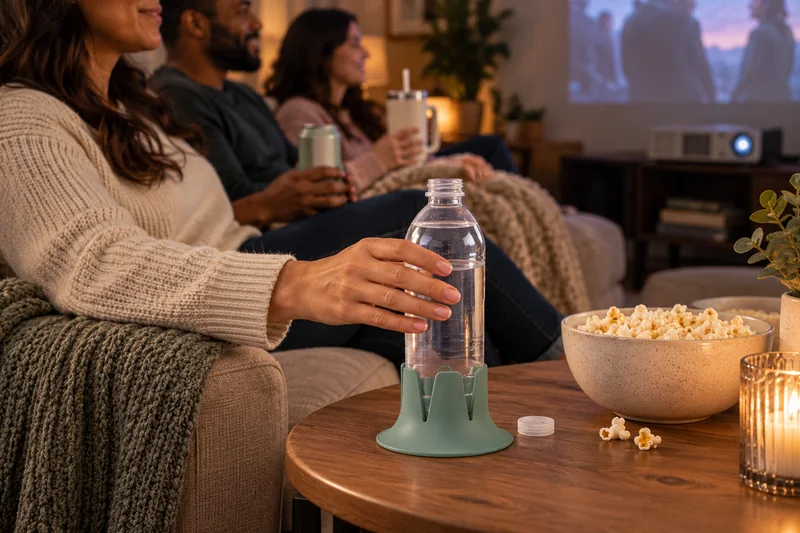
A container base 2 to 3 inches across settles in fully, which covers the can, the bottle, the pint glass, and most tumblers that make it into a theater room, and flexible fins stretch to seat bases as wide as 3.15 inches — a snug fit that takes in the Stanley 40 oz and the Stanley 30 oz both. Under 2 inches, a base is too narrow to grip; a stemmed wine glass narrows to a stem no fin can hold, which is the one shape nothing here solves without pouring into stemless first.

What actually holds a drink steady in this room

A socket can only ever be one diameter. The fix has to work the other way: wide enough at the base that it doesn't need a level, flat spot to stand on — laying its footprint across the curve of an arm top or the flat top of a console instead of finding one high point and leaning off it — and gripping the drink by its bottom inch, regardless of what shape the rim tapers into above that.

That's also what survives the parts of the room built to move a drink around: a recliner's slow motorized glide, a knee landing on the console, a whole row flinching at once. The base flexes with whatever's underneath it and settles the drink back level, instead of letting a bump become a spill headed toward the wiring under the cushion.

None of that requires drilling into an armrest, matching a stemware caddy to someone else's grommet, or trusting a wobbling tray table — just a base wide enough for whatever surface it lands on, with fins that grip the drink you actually brought into the room and hold it steady through the recline, the jump scare, and the third refill.

Head to steadilabs.com →

Checkout is on steadilabs.com — Steadi Labs is the company that makes it.